


EXHIBITION
11 June - 19 July 2026

Zhang Lanpo
Examples of honoring and commemorating founding heroes abound throughout history, both in China and abroad. This is, in itself, a fascinating phenomenon. Whenever conquerors arrive in history, they invariably tell the people that the long-awaited light has come together with their swords and spearheads. Thus, for various reasons and motivations, people begin to stage moving dramas of “bathing in sunlight” amid the darkness of night. Naturally, heroes become one of the eternal themes of this radiant light. Yet in reality, heroes who have killed without restraint are seldom spared the fate of being discarded once their usefulness ends. With predators waiting behind predators, only a rare few are fortunate enough to relinquish power peacefully over a cup of wine. When heads are displayed in the marketplace, the crowd of onlookers likely still includes those who once lined the streets to welcome them.
In Zhang’s Lingyan Pavilion series, he assembles imagined portraits of civil and military officials who expanded territory through conquest and slaughter, using the ashes of abandoned, anonymous individuals. He does not intend these works to correspond to historical records. Grass overtakes desolate tombs; blood soaks the dust of campaigns.
From ancient tribes to imaginable futures, humanity has endlessly forged covenants—old and new—woven like spider webs. Protection and persecution coexist. In The Book of Covenants, he depicts lives extinguished like weeds beneath these shadows.
By closely observing death itself, Zhang encountered the silent yet forceful other half of the world—sweeping away illusion, levelling desire, cleaving into the future. In its shadow, cells divide with crackling intensity—life sprouting, growing.


Shen Zhonghai
Shen's creative thinking originates from an inquiry into the essence of photography and the practice of an experimental spirit. In 2022, when AI imagery first emerged, he did not stop at the discussion of whether it would replace photography. Instead, he first generated a group of works using AI, and then transformed them through the earliest processes of photographic invention, forming a cyclical dialogue.
He does not adhere rigidly to historical authenticity. Rather, he stands in the present, integrating contemporary ideas and technologies in experimental practice. Different from the ancients, different from contemporaries, and different from himself. It is about activating tradition so that, within a contemporary context, something new may grow from tradition.
As a technology introduced from abroad, photography has often led Chinese artists into imitation and following, both in technique and concept. They are accustomed to perfecting the path from 1 to 10, yet rarely create from 0 to 1.
Shen’s works represent an experimental revolution. Facing the future proliferation of AI imagery and virtual worlds, he firmly believes that art needs expression with warmth and material presence more than ever.
Coming from tradition and moving toward the future - the creative path that belongs to our time.


Huang Jun
Using a ninety-nine-metre scroll of Xuan paper
as his canvas, the artist conducted an ink performance
on the beach in Cairns, Australia. This land is home
to Indigenous Australian communities, while the
artist, as a member of the Miao ethnic group from
Guizhou, China, likewise carries a profound Indigenous
cultural heritage.
With the concept of a gift as its medium, the work both
highlights the lineage of Chinese culture and conveys a gesture of friendly exchange. Through the bridge of art, it demonstrates the mission of contemporary Chinese artists: to tell China's story well and to promote cultural exchange between China and Australia.


Gao Kang
In the present era, a cross-generational tool has once again emerged: artificial intelligence, seemingly endowed with limitless potential. However, to truly employ this revolutionary tool for creative practice - rather than mere replication or collage - we must first confront a question that is increasingly shared across society: how can we cultivate sharper perception and deeper sensibility than ever before?
This question has always been fundamental to artistic creation across cultures and eras. Today, however, it no longer belongs solely to artists; it has become the very foundation for effectively engaging with new tools in this century.
How, then, can we extract the primordial fire of art and transform it into a methodology - one that empowers people to act, remains unthreatened by AI, and ensures human agency over its use? This is the central challenge Gao Kang has sought to unravel in recent years through his artistic practice.


Guo Liwei
Through fluid brushwork on paper, Guo reconstructs natural imagery, transforming the spiritual essence of traditional Chinese landscape painting into a contemporary visual language.
His works are both a reflection on the classical philosophy of the unity of heaven and humanity and a meditation on the ecological fractures brought about by rapid urbanisation. Landscape, in his practice, is no longer mere scenery - it becomes a mirror reflecting the evolving relationship between humanity and nature.


Huang Azhong
The colour of Western Impressionism absorbed the expressive spirit of the East. Van Gogh's powerful chromatic lines trace a poetic starry sky; Monet's Rouen Cathedral uses painterly colour to express morning, dusk, evening and mist; Renoir's Mother and Child narrates through colour and sentiment.
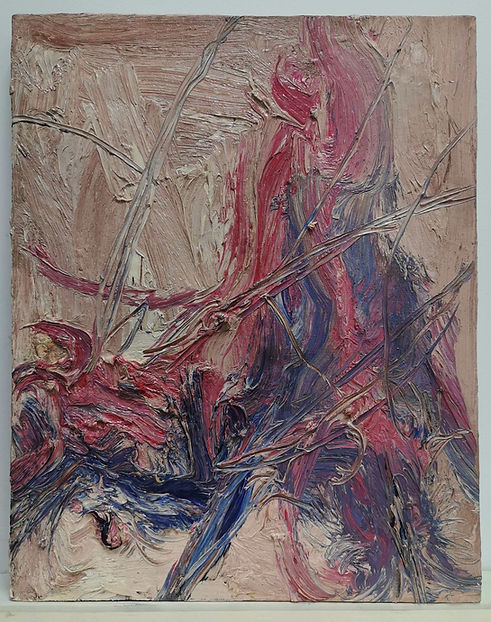
The oil paintings Huang presents in this exhibition have a style different from Impressionist colour. These expressive colours are personal, while also embodying a fusion of Eastern and Western traditions, integrating the freehand spirit of Chinese painting into Western oil painting.
When he paints these small works, the colours on his palette are not complex. By blending a limited number of colours, allowing them to merge with one another, and perhaps adding only a subtle adjustment, colour becomes emotional, poetic, meaningful and atmospheric.
We must build confidence in our own culture. Eastern and Western painting need dialogue, and art needs exchange.


Luo Wei
The Larvae series focuses on the builders who move quietly and tirelessly through the city, using artistic language to reflect on the individual and the times.
With the accumulation of life experience, Luo has come to understand that creation requires sincerity and humility. It should return to life itself and convey an understanding of existence.
During the pandemic, in Shanghai's Nanxiang Guyi Garden after a heavy rainstorm, rainwater soaked his sketchbook, causing the lines to spread into a natural, unfinished texture. This made Luo realise that creation need not pursue perfection; those traces carrying the warmth of life are precisely the truest portrayal of life.
He dried these rain-soaked sketches and brought this unfinished warmth into his creative practice. For Luo, art is a return to the lived moment - an honest expression that conveys reverence for both the times and life itself.



After Dark Mofo, Hobart knows why art matters
The sky is changing. We are living through a time of disruption, uncertainty and profound transformation. The world feels less settled than it did even a few years ago. Technologies are advancing faster than our ability to fully understand their implications. Artificial intelligence is reshaping industries and professions. Economies are navigating a new industrial revolution. Global power is shifting. Societies are becoming more connected, yet also more polarised.
In times like these, many of us instinctively seek solid ground. A walk on the beach or in the bush helps. So does time with friends, family and community. But we can also find perspective in another, less obvious place: art. A visit to an exhibition, an encounter with a work that unsettles or surprises us, can become a way of stepping outside the noise of daily life and seeing the world afresh.
We’ve all observed in Hobart how art can change the way we see ourselves. As Dark Mofo has just wrapped up for another glorious year, the city is again emerging from that strange and familiar midwinter spell in which warehouses, waterfront spaces, churches and streets are transformed into places of encounter, provocation and wonder.
For a few weeks each winter, Hobart becomes more curious, more alive to possibility and more willing to step outside its routines.
Whatever we might personally think about this or that artwork, Dark Mofo has helped us learn that art is not an optional extra to civic life. It can shape the way a place feels, the conversations we have and the confidence with which we present ourselves to the world.
That shift did not begin with Dark Mofo alone. MONA changed Hobart by demonstrating that a city at the edge of the world could also be at the centre of cultural attention. It invited Tasmanians to expect more of our cultural life and to see that serious contemporary art from the world can find its home here. It also changed the way visitors see Tasmania and, more importantly, the way we see ourselves: as people capable of engaging with bold ideas, difficult questions and global conversations, while remaining deeply grounded in our own landscape and character.
That matters because in a world like ours, finding our way is not simply about having more information. Information has never been more abundant. Answers have never been more accessible. The challenge now is making sense of complexity. How do we understand perspectives different from our own? How do we navigate uncertainty when there are no clear answers? How do we remain open to new ideas while staying grounded in our values? How do we build trust, foster collaboration and create shared understanding across cultures and communities?
Perhaps surprisingly, contemporary art can help.
Many people approach art expecting beauty, decoration or entertainment.
Contemporary art often asks something different of us. It challenges assumptions. It invites reflection. It explores tensions between tradition and modernity, individual and society, material prosperity and deeper meaning. Rather than providing answers, it encourages us to ask better questions.
In many ways, that is precisely the capability required in today’s world. As artificial intelligence becomes increasingly capable of generating answers, the more distinctly human qualities become more valuable: curiosity, judgement, empathy, creativity and wisdom. Standing before an artwork that does not immediately reveal its meaning requires patience. It requires observation. It requires us to suspend certainty and remain open to alternative interpretations. It asks us to consider experiences and perspectives beyond our own.
These are not just cultural virtues. They are capabilities for life and work in a rapidly changing world. They underpin effective leadership, successful business relationships and constructive citizenship.
The most resilient people of the future are unlikely to be those who insist they already know all the answers. They will be those who can navigate complexity, connect ideas across disciplines, understand different cultures, build trust and bring diverse groups of people together around a common purpose. Art develops these capacities in ways few other experiences can.
That is one reason contemporary Chinese art is so compelling. Chinese artists are often working at the intersection of multiple worlds. Their work reflects the experience of a society that has undergone extraordinary transformation within a single generation while remaining deeply connected to thousands of years of cultural tradition. Their perspectives can challenge Western assumptions and open up alternative ways of seeing the world. They can help us think more carefully about questions of identity, memory, power, belonging, technology and change — all issues that are shaping the century ahead.
For Tasmanians, there is something especially valuable in this encounter. We live in a place with a strong sense of local identity, a deep attachment to landscape and community, and a growing confidence in our place in the world. Yet we are also part of a wider region and a global economy being reshaped by geopolitical, technological and cultural change. We need to remain grounded, but we also need to keep looking outward. Exhibitions that bring contemporary international artists to Hobart are not simply cultural decoration. They are opportunities to encounter different ways of seeing, thinking and responding to modern life. They expand our imaginative horizons at precisely the moment we most need it.
For anyone seeking to understand the century ahead, spending time with contemporary Chinese art is about much more than appreciating artworks. It is an opportunity to practice seeing complexity rather than simplicity, to cultivate curiosity rather than certainty, to develop empathy rather than judgement, and to understand people rather than stereotypes. These are not luxuries. They are essential capabilities for navigating an increasingly interconnected and uncertain world.
Hobart has already shown, through MONA and Dark Mofo, that art can do more than entertain. It can unsettle complacency, widen horizons and help a community imagine itself differently. At a time when many of us are searching for steadiness amid rapid change, that may be one of art’s most important gifts.
That is part of what 42° South: Shanghai Contemporary Art Observations offers Tasmania. Bringing together the work of seven cutting-edge artists from China, the exhibition invites local audiences into a conversation about transformation, identity, tradition and modernity — questions that resonate as much in Hobart as they do in Shanghai.
It runs until 19 July at the Henry Jones Art Hotel Packing Room Gallery.
David Morris
Executive Producer